
Native iOS

Brief
Let's be honest, users don't "like" ads. They tolerate them at best. Our team's directive was to uncover new ways to increase CTR in order to deliver on lower funnel outcomes for advertisers. However, our real task was balancing on a knife's edge. We needed to increase the presence of, and interaction with, our advertisement surfaces while not bombarding users with a disruptive ad experience that would affect their engagement with the core application.
User research
We knew from previous studies conducted that users had extremely high brand recall (68%+) with audio ads. We applied that data point within the context of our ad ecosystem and formulated a hypothesis. We hypothesized that by showing users a call to action for an audio ad they had previously heard, they would be more likely to engage with the ad.
We ran a small quantitive test using our existing ad framework to establish a baseline and see if there was either a positive or negative trend. We discovered a small lift (+0.15pp) in CTR when we showed users a CTA for an audio ad they had already heard.
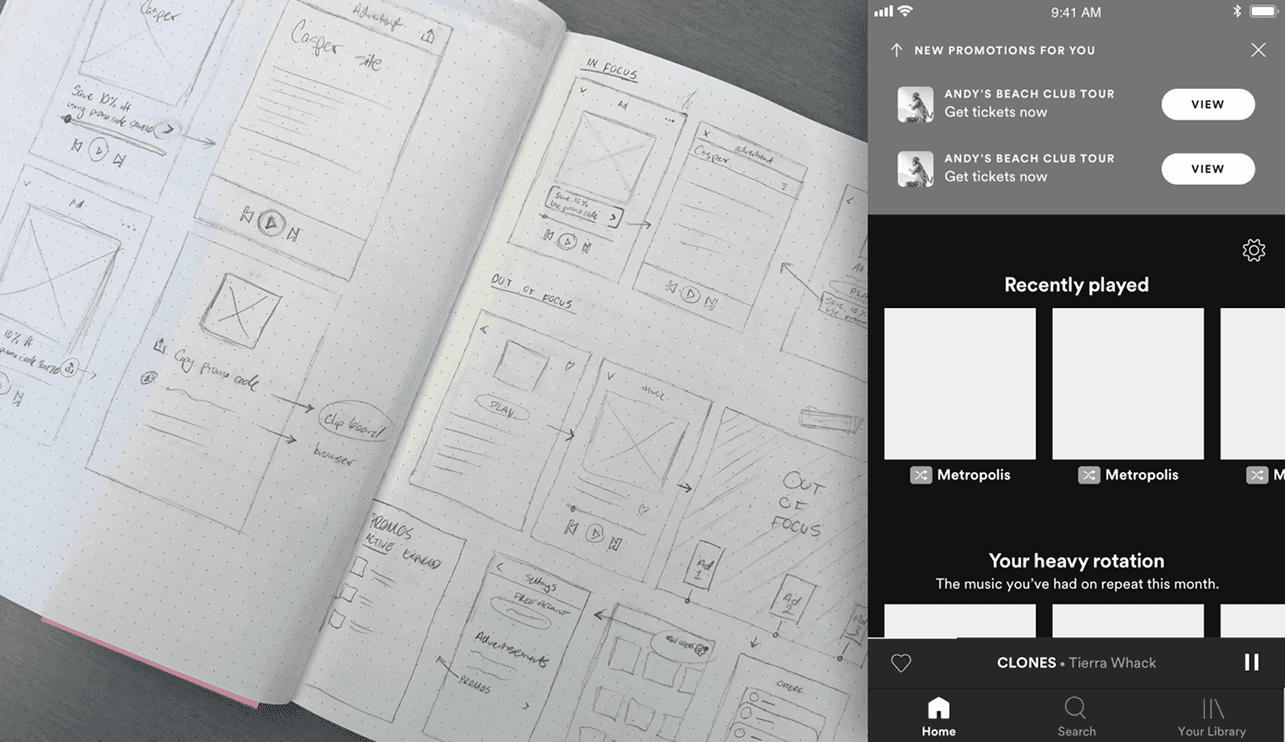
Testing prototypes
Establishing a baseline
Two of our concepts were used to establish a baseline of ad tolerance on the platform.
First, a standard "carousel" interaction nestled in between rows of content on the user's home page. Our concept was to leverage the Home surface as a means of displaying several ads with a contextual label of "Recently played". This would promote the advertisements while still trying to seem personalized and relevant to the user, since these ads were in fact played during their listening session.
Additionally, we tested a time-sensitive banner concept that would momentarily display when the user returned to the Now Playing surface (one of the surfaces with the highest engagement in the app). At the time Spotify already did a (disruptive) version of this. Internally, they were called "Leave Behinds". They were full screen modal overlays for a single ad that was just played in the most recent listening session. Our data suggested that the few times our users engaged with ads were to dismiss them from this Now Playing surface. Hence, our hypothesis was simple: don't interrupt the user and they won't immediately dismiss the ad, potentially increasing visibility and interaction with the ad.
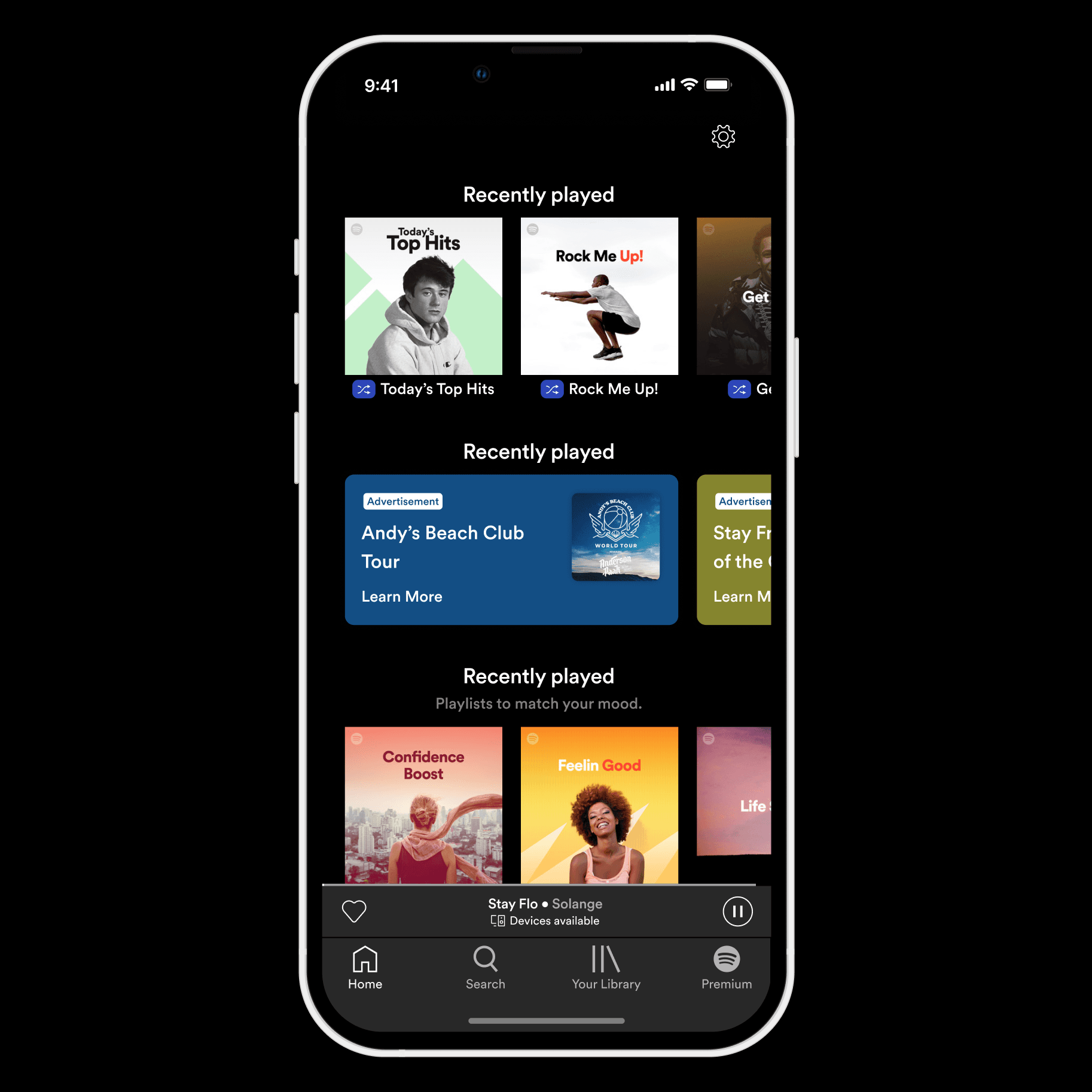
Offering the user true value
Our final testable concept was to offer true value for all users (Free and Paid) in the form of a recent history feature. We could then leverage this new surface to also display the audio ads that were heard during the most recent listening session for Free users. During testing, this concept was received extremely well by all participants. The value of a recent history far outweighed the "cost" of viewing these resurfaced ads. Displaying these ads on an accessible surface and in a chronological order within the context of the listening session was seen as user-friendly and "not pushy". This gave participants the ability to actually explore the available ads without hindering their immediate actions.